| Adaptive cruise control |
Vehicles equipped with forward collision warning or automatic emergency braking |
Forward millimeter-wave radar, commonly mounted behind the grille or bumper area |
The bumper cover must provide the correct radar clearance, mounting position, surface thickness, and approved material in front of the radar. |
Check whether a low-speed front impact can require radar replacement, bracket replacement, aiming, or electronic calibration. |
Use only a bumper configuration listed for the same vehicle year, body style, trim, and sensor package. |
| Parking assistance |
Vehicles with front parking assistance or low-speed obstacle detection |
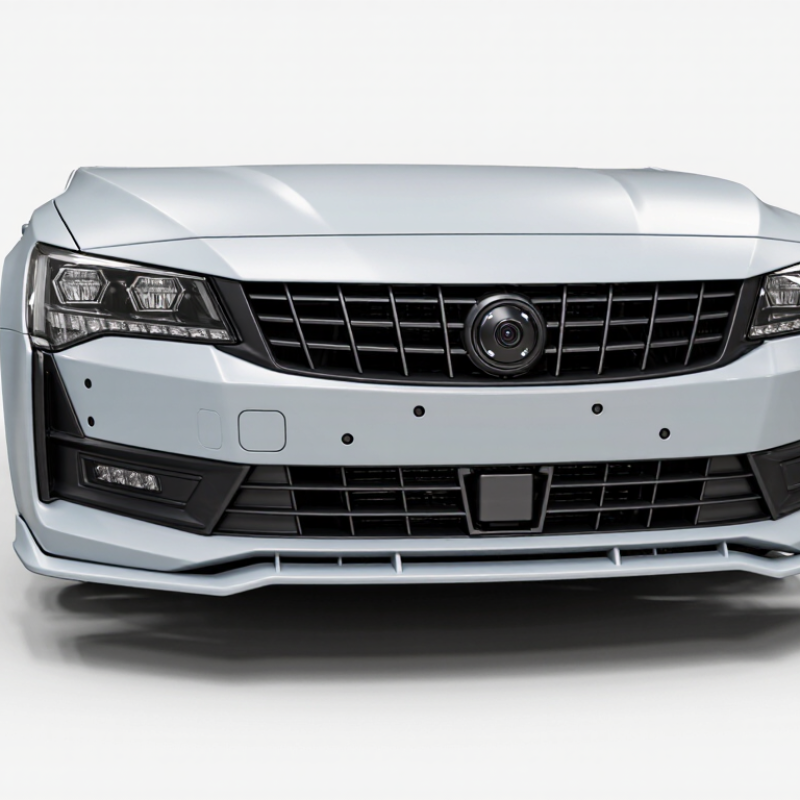
Ultrasonic parking sensors installed in circular openings across the bumper cover |
Sensor holes must match the original number, diameter, spacing, orientation, and mounting retainers. |
Compare the number of damaged or replaced parking sensors, sensor brackets, wiring retainers, and bumper labor operations. |
Select a pre-drilled bumper with correctly positioned sensor mounts rather than modifying a blank cover. |
| Front-view camera system |
Vehicles using a grille-mounted camera for forward visibility, traffic-sign recognition, or camera-based emergency braking |
Forward-facing camera located in the grille, emblem area, windshield, or upper front structure |
The bumper or grille must not obstruct the camera field of view and must retain the correct camera bezel and mounting geometry. |
Verify whether bumper removal or grille replacement requires camera target alignment or dynamic calibration. |
Avoid covers with decorative bars, mesh, badges, or inserts that alter the camera’s viewing area. |
| Blind-spot and cross-traffic support |
Vehicles with rear cross-traffic warning or blind-spot monitoring |
Usually rear-corner radar sensors; front-bumper compatibility is relevant when the replacement package includes shared wiring or sensor modules. |
Confirm that the replacement bumper package does not remove, pinch, or reroute the vehicle wiring harness connected to the ADAS network. |
Review the repair record for harness damage, connector replacement, diagnostic scans, and post-repair system checks. |
Choose a bumper with the correct harness guides, clips, absorbers, and connector access points. |
| Pedestrian protection |
Vehicles designed with pedestrian-impact energy management |
Bumper cover, energy absorber, reinforcement beam, crash brackets, and impact sensors |
The cover must be compatible with the original absorber, reinforcement, impact sensors, and pedestrian-protection structure. |
Use IIHS repairability information to compare structural part replacement, hidden damage inspection, labor time, and calibration requirements after a front impact. |
Do not use a bumper solely because its exterior shape matches; verify all underlying safety components. |
| Bumper material and finish |
Painted, textured, molded, or multi-piece front bumper assemblies |
Thermoplastic bumper cover with sensor bezels, grilles, trim, and lower air openings |
Material, curvature, thickness, paint layers, and surface treatments must not interfere with radar or ultrasonic sensor performance. |
Check repair procedures for paint thickness limits, sensor masking, replacement versus repair, and required diagnostic testing. |
Prefer a cover that follows the vehicle’s approved sensor and paint specifications. |
| Low-speed crash repair exposure |
Front-end impacts at parking-lot or urban speeds |
Bumper cover, absorber, reinforcement, grille, radar bracket, parking sensors, and wiring |
The selected bumper should allow proper access to serviceable parts without forcing unnecessary replacement of undamaged components. |
Compare IIHS repairability data for damaged parts, replacement operations, labor complexity, calibration needs, and hidden damage risk. |
Favor a design with replaceable sensor brackets and accessible fasteners when all safety requirements remain satisfied. |
| Model-year and trim matching |
Different production years, body styles, equipment levels, and regional specifications |
Bumper shell, grille, radar mount, sensor bezel, harness, and air-deflector components |
Part dimensions and sensor provisions must match the exact vehicle configuration, not only the general vehicle name. |
Use vehicle-specific IIHS repairability records and confirm whether the tested configuration has the same ADAS equipment. |
Reject any listing that does not identify model year, body style, trim, sensor package, and installation hardware. |
| Post-installation validation |
Any vehicle with forward radar, camera-based ADAS, parking sensors, or impact detection |
ADAS control module, sensor mounts, wiring, diagnostic system, and calibration targets |
The bumper must be installed without changing sensor angle, height, alignment, or distance from the road surface. |
Confirm that the repair estimate includes diagnostic scanning, fault-code clearing, aiming, calibration, and a functional road test when required. |
Do not treat visual fit as proof of compatibility; require documented ADAS validation after installation. |